Routine Guide
Skincare Routine Order: What to Use First, Next, and Last
Skincare routine order usually starts with cleansing, moves to optional lighter treatment products, then finishes with moisturizer and sunscreen during the day.

Quick Answer
In the morning, cleanse, apply treatment products if needed, moisturize, and finish with sunscreen. At night, remove buildup, cleanse, apply optional treatments, and finish with moisturizer.
Many people are less confused about which skincare products exist than about what order to use them once they get home.
This guide simplifies the sequence by showing what usually comes first, what comes next, and which steps are optional rather than mandatory.
Key Takeaways
- A simple skincare routine generally moves from cleansing to treatment products, then moisturizer, with sunscreen last in the morning.
- Applying products from lighter textures to heavier ones is a useful general guide, not a rigid rule for every formula.
- Morning routines usually prioritize cleansing, optional treatment, moisturizer, and daytime sunscreen.
- Evening routines usually remove the day’s buildup, apply optional treatments, and finish with moisturizer.
- You do not need every step; introducing one treatment product at a time makes your routine easier to understand and your skin’s response easier to assess.
Choose This Approach If...
- You feel unsure about what order to apply skincare products
- You want a beginner-friendly routine that makes practical sense
- You are trying to simplify your routine instead of copying a long one
The basic order: clean, treat, moisturize, protect
Most routines can be understood as four jobs:
- Clean the surface. Remove buildup so the next step is not being applied over sweat, makeup, or excess oil.
- Apply a treatment, if you use one. This may be a product chosen for a particular concern or a medication directed by a professional.
- Moisturize. Add comfort and help reduce moisture loss.
- Protect during the day. Sunscreen is the final skincare step in the morning, before makeup.
This is a framework, not a requirement to buy four products. If you do not use a treatment product, skip that step. If your skin does not need a separate product category, leave it out.
The American Academy of Dermatology’s guidance on product order supports this basic sequence while emphasizing that treatment instructions and skin tolerance still matter. “First, next, and last” should make a routine clearer, not force every person into the same number of steps.
A simple morning skincare routine
1. Cleanse
Start with a gentle cleanser if your skin needs one. The goal is to create a clean starting point, not to leave your face feeling tight or stripped. Some people with very dry or sensitive skin prefer a lighter morning cleanse; what matters is how your skin responds.

2. Apply treatment products, if needed
This is where a serum or other treatment product may fit. Examples include hydrating, brightening, or texture-focused products. You do not need several treatments simply because they can be layered together.
If you use a prescription medication or another treatment recommended by a clinician, follow those instructions first. The American Academy of Dermatology advises applying medication or other treatment right after cleansing.
3. Moisturize
Apply a moisturizer that feels comfortable for your skin. A light gel may be easier to wear on oily skin, while a richer cream may feel more comfortable on dry skin. The right choice is the one you can use consistently without discomfort.
4. Apply sunscreen
Sunscreen is the final skincare step in a morning routine, before makeup. The FDA explains that broad-spectrum sunscreen helps protect against both UVA and UVB radiation and should be used with other sun-protection measures. Follow the product label for application and reapplication instructions.
A simple evening skincare routine
1. Cleanse
In the evening, cleanse away sunscreen, makeup, sweat, and the day’s buildup. Many people need only one gentle cleanser. If you wear heavy or water-resistant products, you may prefer a two-step removal process, but it is not automatically necessary for everyone.
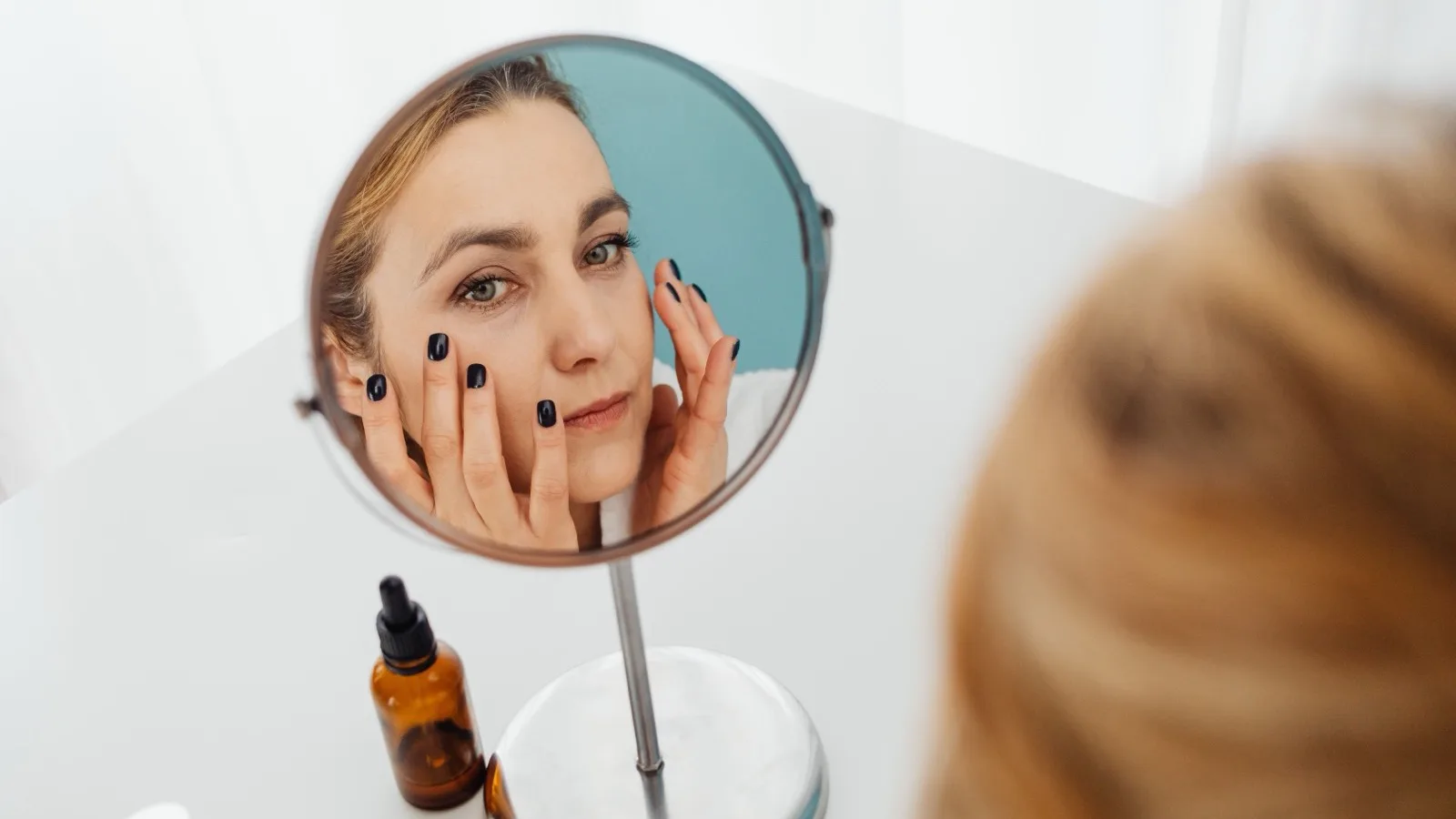
2. Apply an evening treatment, if needed
Use the treatment that belongs in your evening routine according to its instructions. Avoid stacking several strong products simply to make the routine feel more complete. If you are introducing something new, adding one product at a time makes it easier to understand how your skin responds.
For a new product, follow the label and consider testing a small area first. The AAD’s testing guidance is particularly relevant when you are adding an active treatment or changing several parts of a routine.
3. Moisturize
Finish with moisturizer. Your evening moisturizer does not need to be dramatically different from your morning moisturizer, although some people prefer a richer texture at night.
Essential versus optional products
The long version of a skincare routine can include many categories. That does not mean every category is essential.
| Product category | Role in a routine | Is it essential? |
|---|---|---|
| Cleanser | Removes buildup from the skin | Often useful, depending on your routine and skin |
| Treatment or serum | Addresses a specific goal | Optional unless prescribed or needed for your goal |
| Moisturizer | Adds comfort and helps reduce moisture loss | Often useful |
| Sunscreen | Helps protect exposed skin during the day | Important for daytime sun protection |
| Toner or essence | Adds another liquid step after cleansing | Optional |
| Exfoliant | Provides additional exfoliation | Optional and not automatically an everyday step |
| Eye cream | Targets the eye area as a separate product | Optional |
| Face oil | Adds an occlusive layer for some routines | Optional |
Cleveland Clinic’s guidance on skincare order also emphasizes a simple minimum routine and treats several product categories as optional. Use that principle as a decision filter: every product should have a clear job.
Where toner, essence, and exfoliants fit
Toner or essence
If you use a toner or essence, it generally comes after cleansing and before a serum or moisturizer. But skipping it does not leave your routine incomplete. Product names can overlap, so focus on what the product is designed to do and how your skin tolerates it.
Exfoliant
An exfoliant generally comes after cleansing and before heavier products. It is not an automatic daily requirement. Use the product according to its directions, introduce it cautiously, and reduce or stop if your skin becomes irritated.
Eye cream
Eye cream is an optional category. If you use one, place it after lighter treatment products and before moisturizer, unless the product directions say otherwise.
Face oil
Face oil is usually used near the end of a routine because it can form a more occlusive layer. It is optional, and it may not suit every skin type or goal.
Common mistakes to avoid
Treating a long routine as a required routine
More steps do not automatically mean better results. Start with the smallest routine that addresses your actual needs, then add only what has a clear purpose.
Adding several new products at once
When multiple products are introduced together, it becomes difficult to know what is helping or irritating your skin. The AAD warns that using too many products, particularly multiple anti-aging products, may irritate the skin. Add changes gradually when possible.
Treating “thin to thick” as an absolute law
Applying lighter products before heavier ones is a useful general convention, but it does not override medication instructions, product directions, or professional advice. The purpose of the sequence is to make the routine sensible—not to turn a guideline into a rigid rule.
Skipping moisturizer because your skin is oily
Oily skin can still feel uncomfortable or dehydrated. Choose a texture you can tolerate rather than assuming moisturizer is only for dry skin.
Using sunscreen as a replacement for all sun protection
Sunscreen is one part of sun protection. The FDA also recommends measures such as limiting exposure, wearing protective clothing, and reapplying sunscreen as directed.
How to simplify your routine
If your routine feels overwhelming, return to the basics for a while:
Morning
- Cleanse if needed.
- Apply a treatment product if you have a clear reason to use one.
- Moisturize.
- Apply sunscreen.
Evening
- Cleanse.
- Apply a treatment product if needed and appropriate for the evening.
- Moisturize.
Then ask of every additional product: What job is this doing, and is it helping enough to justify the extra step?
When to get professional advice
If a product causes persistent irritation, or if you are using medication for a skin condition, follow the instructions from your clinician or pharmacist rather than relying on a generic product-order rule. Stop using a product that clearly causes a concerning reaction and seek appropriate professional advice.
Frequently asked questions
Does serum go before moisturizer?
Usually, a serum goes before moisturizer because it is typically a lighter treatment layer. Follow the product directions if they specify a different use.
Does sunscreen go before or after moisturizer?
Sunscreen generally goes after other skincare products and before makeup in a morning routine. Follow the sunscreen label and any professional instructions relevant to your situation.
Do I need toner?
No. Toner can be part of a routine, but it is optional. If you use one, it generally follows cleansing and comes before serum or moisturizer.
Do I need a ten-step routine?
No. A shorter routine is often easier to follow and evaluate. Begin with the essential steps, then add a product only when it addresses a specific need.
Can I use all my treatments together?
Do not assume that every treatment should be layered together. Check product directions, introduce changes gradually, and seek professional guidance if you are combining medications or dealing with persistent irritation.
Where to go next
Once you understand the order, the next decision is choosing which products deserve a place in your routine:
- Skincare Routines and Segments: How to Choose a Path That Fits You
- Skincare Product Categories Explained
- Which Skincare Products Do You Actually Need?
- Korean Skincare Guide: Products, Routine Steps, and What to Buy First
The best routine is not the longest one. It is the one whose steps have a clear purpose, whose products your skin tolerates, and which you can follow consistently.